PDF export converts wiki pages and books into PDF files. PDF templates control the layout and formatting of the exported PDF, including the page orientation, cover page, header, footer, table of contents, links, and attachments.
Export a page or book
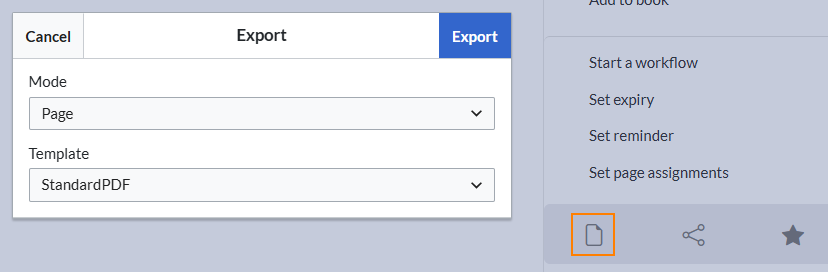
To export a page or book to PDF:
- Open the page to export.
- Open Page tools.
- Open More actions.
- Select Export as PDF.
- Select the export settings.

Export modes
The available Mode options depend on the current page. Modes that are not applicable are not shown.
- Page: Exports the current page.
- Page with subpages: Exports the current page and all its subpages. This option is available only if the page has subpages.
- Page with linked pages: Exports the current page and pages that are directly linked from it. This option is available only if the page has linked pages.
- Book: Exports all pages of the book in the defined book order as a single PDF document. This option is available only when the current page is part of a book. When a book template is selected, the exported PDF also includes a cover page.
PDF templates
The Template setting determines the layout and formatting of the PDF:
- StandardPDF: Exports the page or pages without a cover page, unless the template has been customized.
- StandardBookPDF: Exports the page or pages with a cover page, unless the template has been customized.
Custom PDF templates can be created and configured as described in Create a PDF template.
Export media links and attachments
By default, media links that point directly to a file on the server add the corresponding file as an attachment to the exported PDF. This behavior is independent of the selected export mode.
This also applies to PDF files embedded with the Content Droplet PDF preview.
The Allow attachments template property controls whether linked files are added as PDF attachments. See PDF template properties.
Export pages with linked pages
When Page with linked pages is selected, links are processed as follows:
- Page links: Link to the corresponding page in the PDF. If the linked page is not included in the PDF, the link opens the page in the wiki.
- File links: Link to the corresponding file page.
- Mentions: Link to the corresponding user page.
The Disable links in PDF template property controls whether links to targets that are not included in the PDF are disabled. See PDF template properties.
Create a PDF template
Two PDF templates are available by default:
- StandardPDF: Template without a cover page.
- StandardBookPDF: Template with a cover page.
The default StandardPDF template uses the wiki logo configured in the skin settings. If no custom logo is configured, the default BlueSpice logo is used.
Copy an existing template
To create a PDF template:
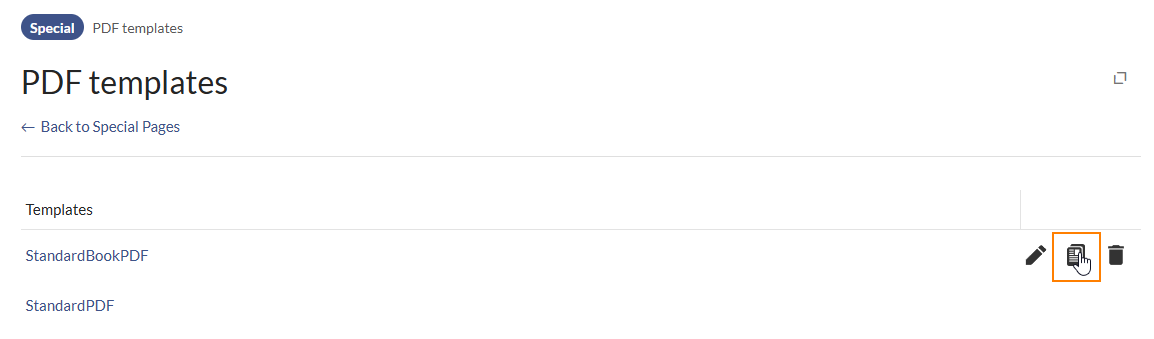
- Go to
Special:PDF_templates. - Copy an existing template.
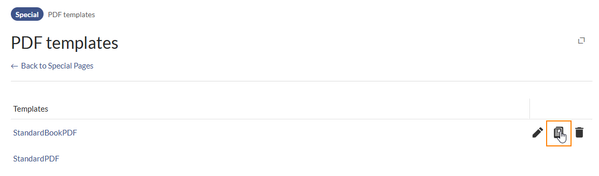
Copy a template - Enter a name for the new template.
- Select Copy.
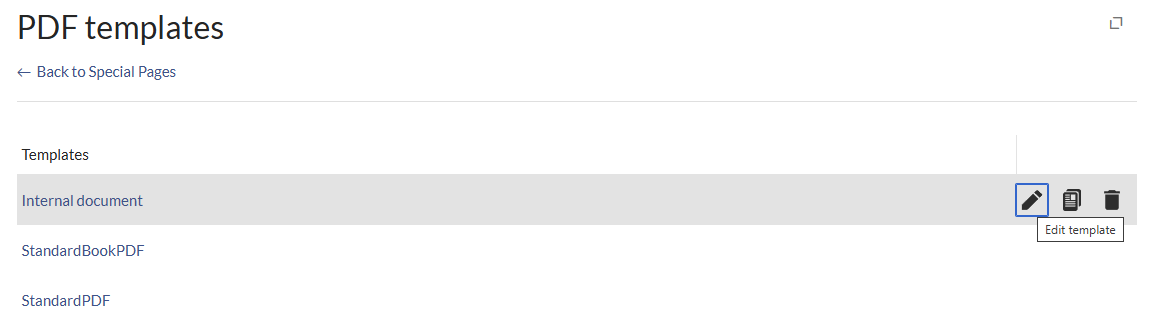
- Select Edit template to start customizing the template.
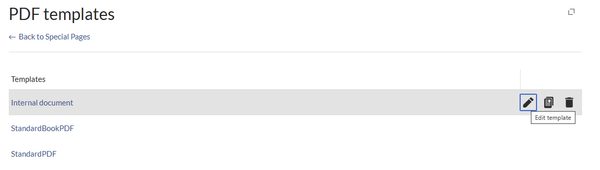
Edit template properties

Select general template properties
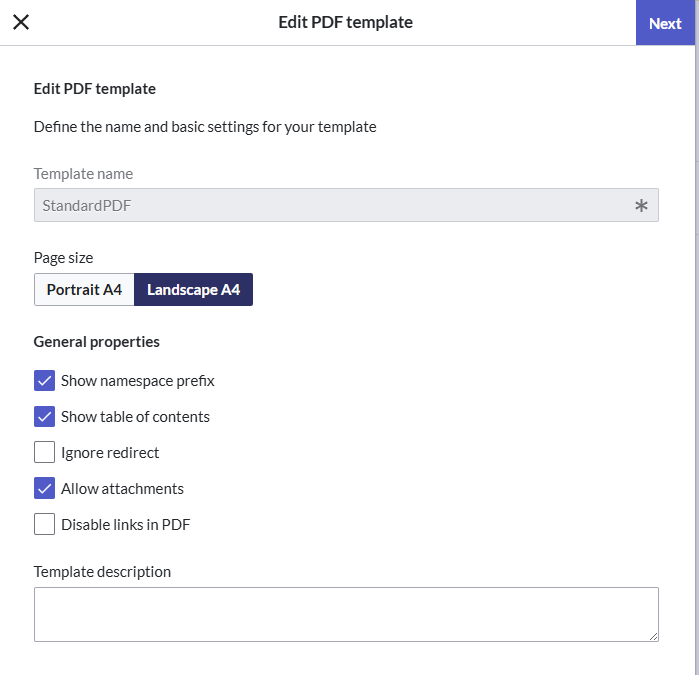
- Select the page orientation and the general export properties.
- Select Next.
Configure properties such as the table of contents, links, and attachments.
Select the template elements
Select the checkboxes for the elements to include in the template:
- Header: Page header for the template pages.
- Footer: Page footer for the template pages.
- Document preface: Cover page.
- Document appendix: Additional page at the end of the PDF. It uses the same formatting as the content pages, including the header and footer, and is included in the PDF page count.
Select Configure for each selected element to design its layout.
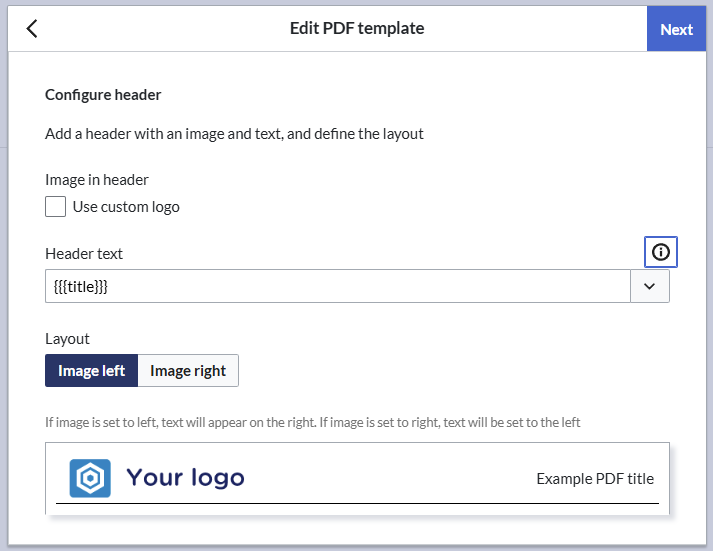
Configure the header
The header can contain an image, usually the wiki logo, and text. The text can combine predefined parameters with custom text.

To use an image other than the wiki logo, select Use custom logo and enter the name of an existing image or upload a new image.
Configure the footer
The footer can contain predefined system messages or custom text.
Localization system messages can be used when the PDF should adapt to the language settings of users. For example, the English system message This PDF is created automatically can be customized on MediaWiki:pdfcreator-pdf-disclaimer. The German language version can be customized on MediaWiki:pdfcreator-pdf-disclaimer/de.
Alternatively, enter custom text when language-specific output is not required. Leave a footer section blank to omit its text.
Configure the document preface
The document preface is the cover page. It is primarily used for book exports but can also be used for page exports.
The PDF export uses background images in the following order:
- If a bookshelf image exists, the export uses it for a Book PDF export.
- If no bookshelf image exists, the export uses the default image defined in the Configuration Manager.
- If a custom image is defined in the PDF template, the export uses the custom image for the Book PDF export.
To use no background image on the PDF cover page, remove the image definitions from all three locations.
For detailed information about creating custom cover sheets, see Custom cover sheets.
PDF template properties
Configure the following PDF template properties:
{
	"embed-page-toc": true,
	"nsPrefix": true,
	"attachments": true,
	"suppress-links": false,
	"no-redirect": true,
	"coverBackground": ""
}
| Label | Name | Default value | Description |
|---|---|---|---|
| Show table of contents | embed-page-toc
|
true
|
Includes the table of contents of each exported page. This applies to both the book table of contents and the table of contents of the individual pages it contains. If set to .pdfcreator-type-page .toc { display:none !important; }
In this case, a table of contents is generated only at the beginning of the PDF. .pdfcreator-type-page .toc { display:block !important; }
|
| Hide namespace prefix | nsPrefix
|
true
|
Suppresses the namespace prefix for page names in the header, footer, and PDF cover page. |
| Allow attachments | attachments
|
true
|
Adds files directly linked with Media: syntax as attachments to the PDF.
|
| Ignore redirect | no-redirect
|
false
|
If a link redirects to a different page, the target page is not included in the PDF. |
| Disable links in PDF | suppress-links
|
false
|
Replaces links with a span element if they do not link to a target within the PDF. |
| - | coverBackground
|
<File:filename.png>
|
Set programmatically when a custom cover background image is provided. |
PDF template elements
Each PDF template consists of the following elements, or slots:
| Template element | Description |
|---|---|
| Header | The page header of each PDF page. |
| Content | The layout of the page content. |
| Footer | The page footer of each PDF page. |
| Document preface | The cover page. It is primarily used for book exports but can also be used for page exports. |
| Document appendix | The last page of the PDF export. It has no predefined basic structure. |
| Styles | CSS style declarations for the classes used by the template elements. See PDF template styles for styling examples and recommendations. |
| Properties | The export properties described in PDF template properties. |
| Description | Internal notes for the template. The description does not affect the template itself. |
All templates are saved as subpages of MediaWiki:PDFCreator. The template subpages contain the syntax for the individual template elements.
Header
The basic structure of a header is:
<div class="pdfcreator-runningheaderfix">
	<table>
		<tr>
			<td>
				<div class="pdfcreator-runningheader-logo">
					{{{logo}}}
				</div>
			</td>
			<td>
				<h1 class="title">{{{title}}}</h1>
			</td>
		</tr>
	</table>
</div>
.pdfcreator-runningheaderfix is required to top-align the header on the page. It works together with the corresponding class declaration in the Styles tab. Both need to be modified together.Content
The content layout uses the following parameter:
{{{content}}}
Footer
The basic structure of a footer is:
<div class="pdfcreator-runningfooterfix">
	<table>
		<tr>
			<td>
				<span>{{int:pdfcreator-pdf-disclaimer}}</span>
			</td>
			<td>
				<span>{{int:pdfcreator-pdf-export-time}}:{{#time:d.m.Y|now}}</span>
			</td>
			<td>
				<span>{{int:pdfcreator-pdf-param-currentpagenumber-label}} </span>{{{currentpagenumber}}}
				<span> {{int:pdfcreator-pdf-param-totalpagescount-label}} </span>{{{totalpagescount}}}
			</td>
		</tr>
	</table>
</div>
.pdfcreator-runningfooterfix is required to top-align the footer on the page. It works together with the corresponding class declaration in the Styles tab. Both need to be modified together.Document preface
The document preface is the cover page. The basic structure for a book cover page is:
<div class="pdfcreator-intro">
	<div class="pdfcreator-intro-title">{{{title}}}</div>
</div>
.pdfcreator-intro is required to display the image for the {{{logo}}} parameter. Without this class, the {{{logo}}} parameter has no effect.PDF template styling
Detailed guidance and examples for customizing PDF template styles are documented on PDF template styles.
The styling documentation covers CSS-based adjustments to the appearance of PDF output. It is intended for advanced template customization.
Configuration
INSERT NEEDED
Prepare content for PDF export
The formatting of wiki content can affect the PDF output. Test the PDF output when working with complex tables or images.
Text-only tables
The following information applies to tables containing only text. Tables containing images follow different rules.
Column widths
When table content requires more space than the available PDF width, the column widths are recalculated to fit the available space while preserving the original table formatting as far as possible.
Use the following approaches to control column widths:
- No column widths and no table width: Column widths are determined by the content. The proportions of the table are generally preserved in the PDF.
- Ratio of column widths: Set a fixed pixel width for each column to preserve their relative proportions. The columns are resized proportionally to fit the available PDF width.
- Preserve selected column widths: To keep specific columns at their defined width, leave at least one column without a predefined width.
- Percentage widths: Set some or all column widths as percentages. These widths are reflected in the PDF output.
Long words
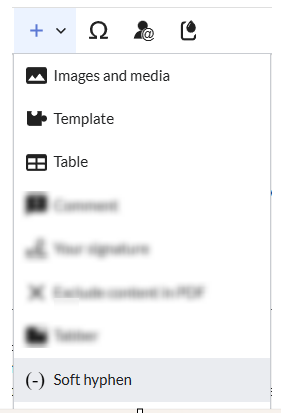
If a long word does not fit within a defined cell width, insert a soft hyphen. The hyphen is applied only when a line break is required.

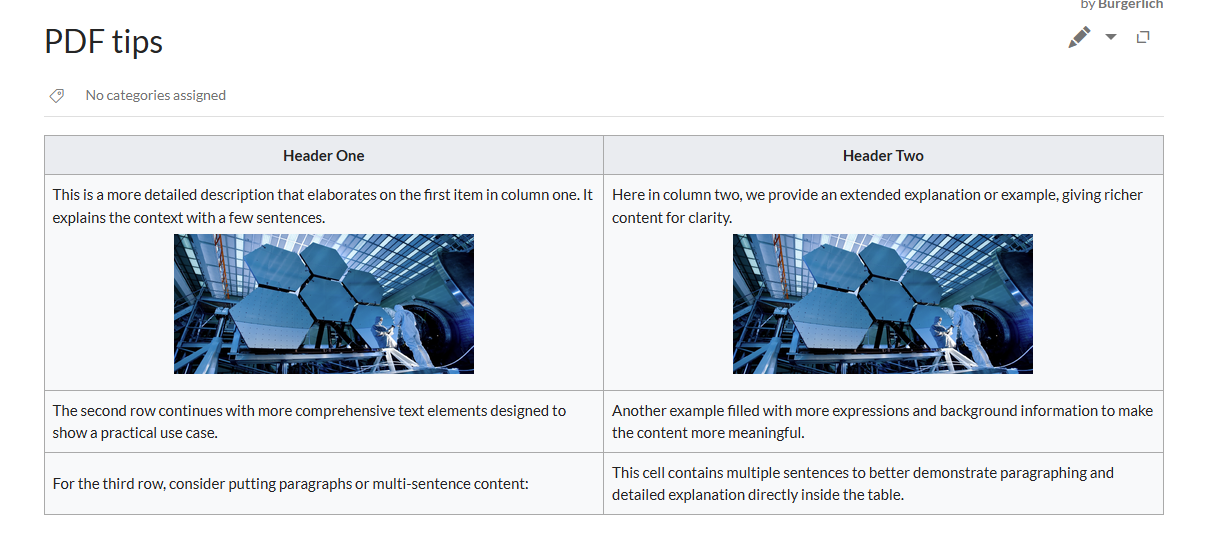
Images in table cells
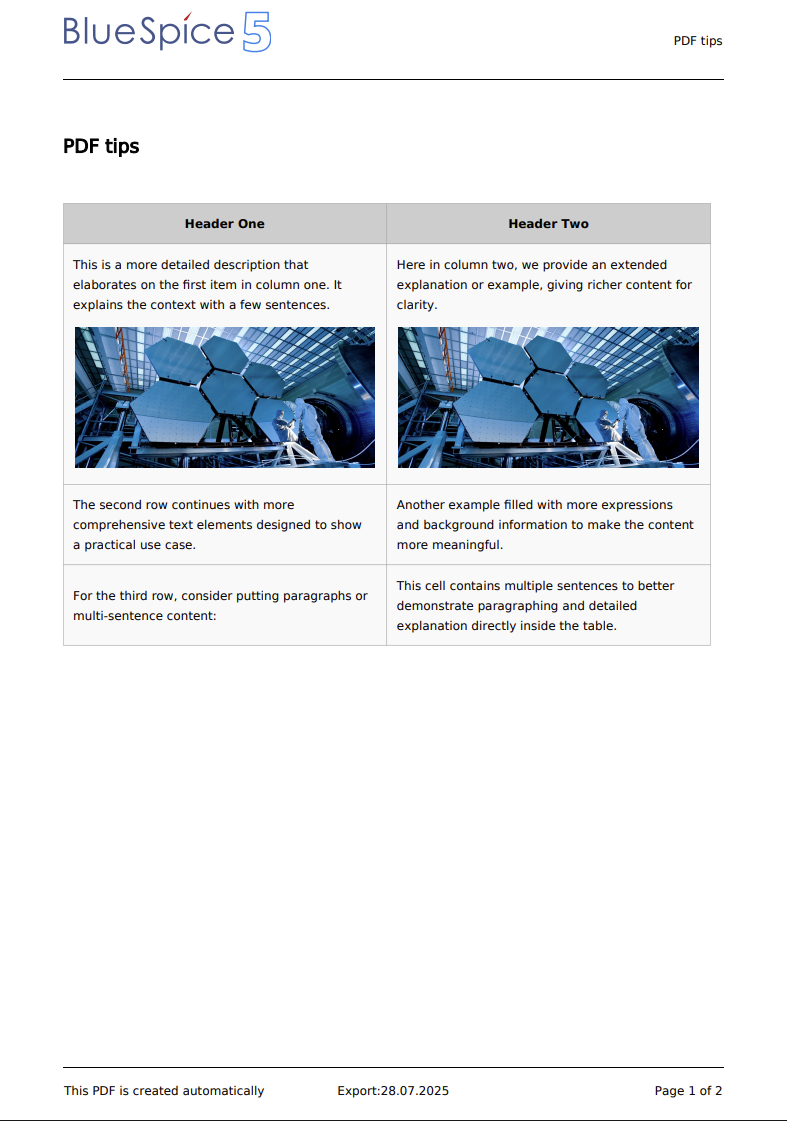
Images in table cells are resized to the defined cell width on the wiki page, but not during PDF export. For example, a 400px-wide image in a 200px-wide column is displayed at 200px on the wiki page, while the PDF export uses the actual 400px image size.
Size images to match the available cell width and test the PDF output.
When images are placed in multiple columns, the combined image width should not exceed 600px. For example, two images with a width of 300px each use the available space in the PDF.

The resulting PDF is shown below:

The example uses modified StandardPDF template styles with a smaller font size and additional table-cell padding:
/* Table styling for wikitable */
.wikitable th, .wikitable td {
    font-size:9pt;
    padding:10px
}
Landscape PDF export
PDF export can use landscape orientation for the entire PDF. Landscape orientation is defined in the PDF template.
To create a landscape template:
- Copy the StandardPDF template.
- Give the new template a name, for example
StandardPDF landscape. - Set the template orientation to Landscape.

Related Content Droplets
The following Content Droplets are related to PDF export:
| Droplet | Description |
|---|---|
| Book PDF link | Inserts a link to a book. Selecting the link immediately downloads the PDF. |
| PDF link | Inserts a link to the same or another page. Selecting the link immediately downloads the page as a PDF. |
| PDF preview | Opens the PDF directly in a PDF viewer on the page. |
| Exclude content in PDF | Wraps content in <pdfexcludestart />...<pdfexcludeend /> tags. Content between the tags is excluded from the PDF export. The inserted markers are not visible in view mode. |
| PDF page break | Inserts a manual page break in the PDF. The inserted page-break marker is not visible in view mode. |
Depending on the requirements, the templates can be newly created in the wiki. For complex customizations, the support of a developer is required.
Exporting a page or a book
To print a page to PDF, click on the page-icon in the page tools. This opens the export dialog field.
Select the export settings.
- Mode:
- Page: Prints the page.
- Page with subpages: Prints the page and all its subpages. This option is only shown if the page has subpages.
- Page with linked pages: Prints the page and the pages that are linked directly from this page
- Template:
- StandardPDF: This prints the page or pages without a cover sheet (unless the template has been edited).
- StandardBookPDF: This adds a cover sheet to the PDF (unless the template has been edited).
Exporting media links
By default, media links (=links that point directly to the file on the server) will add an attachment to the exported PDF File. This is independent of the chosen export mode (Page, Page with linked pages).
This is also true for PDF files that are embedded via the Content Droplet PDF preview.
Exporting pages with linked pages
When pages are exported with their linked pages, link types are processed as follows:
- Page links lead to the corresponding page directly in the PDF or, if not present in the PDF, to the page in the wiki.
- File links are clickable and forward to the corresponding file page.
- Mentions are clickable and forward to the user page.
Adding a new template
By default, the wiki provides two PDF templates:
- StandardPDF: Template without a cover page for the single-page export.
- StandardBookPDF: Template with a cover page for the book export.
Starting with BlueSpice 5.1, PDF templates can be created from the page Special:PDF templates.
By default, the template StandardPDF shows the wiki's logo (from the skin settings page). If there are no custom settings, the default BlueSpice logo is used.
Copy an existing template
To create a new PDF template:
- Go to the page Special:PDF_templates.
- Copy an existing template.
Copy a template - Enter a name for the new template.
- Click Copy.
- Click Edit template to start customizing your template.

Select general template properties
- Select the page orientation and the general export properties (for example, whether to show the Table of Contents for each page or whether to include links to pages that are not exported in the PDF itself).
- Click Next.
Select the template elements
Select the checkboxes for each element you want to include in your template:
- Header: Page header for the template pages
- Footer: Page footer for the template pages
- Document preface: Cover page
- Document appendix: Additional page that is added at the end of the pdf. It is formatted like the content pages (with header and footer) and adds to the PDF page count.
Click Configure for each template element to design the layout.
Configure the header
The header elements can consist of a header image (usually your logo) and some text (which can be a combination of predefined parameters and your own text).
If you want to show an image that is different from your wiki logo, you can select "Use custom logo" and enter an existing image name or upload a new image.
Configure the footer
By default, the wiki provides localization system messages for each footer section. Use system messages if you want to support the language settings of your users. For example, in an English wiki, the English system message for {{int:pdfcreator-pdf-disclaimer}} can be changed on the page MediaWiki:pdfcreator-pdf-disclaimer. the German language version on page MediaWiki:pdfcreator-pdf-disclaimer/de.
Alternatively, you can simply type your own text if the PDF export does not have to consider user languages. Or leave the section blank if you don't want to print text.
Configure the document preface (PDF cover)
You can define the following elements on your cover page:
Background image:
- If a bookshelf image exists, the bookshelf image is used as cover image for the Book PDF export.
- If no bookshelf image exists, the default image defined in the Configuration Manager is used as cover image for the Book PDF export.
- If a custom image is defined in the PDF template, the custom image will be used for the Book PDF export.
If you do not want to use any background image on your PDF cover page, all three locations for defining a book image must be empty.
Properties
The following properties can be configured:
{
	"embed-page-toc": true,
	"nsPrefix":true,
	"attachments": true,
	"suppress-links": false,
	"no-redirect": true,
	"coverBackground": ""
}
| Label | Name | Default value | Description |
|---|---|---|---|
| Show table of contents | embed-page-toc | true | The table of contents for each exported page is included. This applies to both the book table of contents and the table of contents of the respective pages it contains.
If set to The two types of table of contents can be separated from each other using CSS on the "embed-page-toc:" true, the table of contents can be suppressed on individual pages as follows: .pdfcreator-type-page .toc { display:none !important; }
"embed-page-toc":false and then on the page Mediawiki:Common.css:.pdfcreator-type-page .toc { display:block !important; }
|
| Hide namespace prefix | nsPrefix | true | Suppresses the output of the namespace prefix for all page names in the header, footer, and PDF cover page. |
| Allow attachments | attachments | true | If files are directly linked with syntax Media: , the files are also attached in the pdf.
|
| Ignore redirect | no-redirect | false | If links are redirecting to a different page, the target page is not included in the pdf. |
| Disable links in PDF | suppress-links | false | Replaces all links in the pdf with a span-element if they do not link to a target within the pdf. |
| - | coverBackground | <File:filename.png> | This property is set programmatically when a custom cover background image is provided. |
PDF template slots
All templates are saved as subpages of MediaWiki:PDFCreator.
There, you can see the syntax for the different template elements.
Template elements
Each template consists of the same elements (slots):
| Template slot | Description |
|---|---|
| Header | The page header of each PDF page. The basic structure is:<div class="pdfcreator-runningheaderfix">
<table>
<tr>
<td>
<div class="pdfcreator-runningheader-logo">
{{{logo}}}
</div>
</td>
<td>
<h1 class="title">{{{title}}}</h1>
</td>
</tr>
</table>
</div>
Important!The class .pdfcreator-runningheaderfix is necessary to top-align the header on the page. It works in conjunction with the class-declaration in the "Styles" tab of the template. Both need to be modified together. |
| Content | The content layout. The basic structure is:{{{content}}}
|
| Footer | The page footer of each PDF page. The basic structure is:<div class="pdfcreator-runningfooterfix">
<table>
<tr>
<td>
<span>{{int:pdfcreator-pdf-disclaimer}}</span>
</td>
<td>
<span>{{int:pdfcreator-pdf-export-time}}:{{#time:d.m.Y|now}}</span>
</td>
<td>
<span>{{int:pdfcreator-pdf-param-currentpagenumber-label}} </span>{{{currentpagenumber}}}
<span> {{int:pdfcreator-pdf-param-totalpagescount-label}} </span>{{{totalpagescount}}}
</td>
</tr>
</table>
</div>
Important!The class .pdfcreator-runningfooterfix is necessary to top-align the header on the page. It works in conjunction with the class-declaration in the "Styles" tab of the template. Both need to be modified together. |
| Document preface | The cover page. It is meant for the book export, but can also be used for a page export. The basic structure for a book cover page is:<div class="pdfcreator-intro">
<div class="pdfcreator-intro-title">{{{title}}}</div>
</div>
Important!The class .pdfcreator-intro is necessary to display the image for the {{{logo}}}-parameter. Without this class present in the template, the {{{logo}}}-parameter has no effect. |
| Document appendix | The last page of the PDF export. It has no predefined basic structure. |
| Styles | Style declarations for the CSS classes that are used in any of the template elements. You can view the standard styles here. |
| Properties | see section #Properties |
| Description | Internal notes for the usage of this template. The description has no effect on the template itself. |
Configuration
{{#dpl:title=Manual:Extension/BlueSpiceConfigManager|include=#PDFCreator}}
Customizations
To do some granular style changes, you can navigate to your PDF template at MediaWiki:PDFCreator. There, select your PDF template which is a subpage of the PDFCreator page. Switch to edit mode and make your changes in the tab "Styles".
#wrapper) in the styles of PDF templates as selectors. This could lead to conflicts with jump links or other functions. Therefore, you need style classes (.wrapper) that you can target for PDF export.Therefore, when troubleshooting issues with the customized PDF template, any adjustments made within the wiki itself should also be taken into account.
Adjust logo size
The template does not resize the logo automatically. To scale it, you can try to add a custom height to the styles. Find the following rule and overwrite it. Alternatively, you can add this rule at the end of your styles.
/* Logo in Kopfzeile positionieren */
.pdfcreator-runningheaderfix > table .pdfcreator-runningheader-logo img {
       width: auto!important;
       height: 1cm!important;
       margin-top: 0.5cm;
}
After saving your change, do a test print. Go back to your "Styles" tab and adjust the logo height as needed.
Show a semantic property
It is possible to print a semantic property value in any template slot. The following example prints the value of the property "Revision_ID" of a page in the PDF footer.
<div class="pdfcreator-runningfooterfix">
	{{#show:{{FULLPAGENAME}}|?Revision_ID}}
</div>
Background color for header and footer
In the Styles tab, add:
/* add a background color to the header and footer */
.pdfcreator-runningheaderfix, .pdfcreator-runningfooterfix {
    background-color: #eee;
}
This adds a grey background color.
Remove the underline from the header and footer
In the Styles tab, add:
/* remove the border from the header */
.pdfcreator-runningheaderfix > table {
    border-bottom: none !important;
}

/* remove the border from the header */
.pdfcreator-runningfooterfix > table {
    border-top: none !important;
}
Remove table of contents from individual pages of a book
The table of contents at the beginning of a PDF should be displayed, but not the table of contents for the individual pages in the book.
In the "Styles" tab, add:
/* Do not display the TOC of individual pages */
.pdfcreator-type-page .toc {
    display:none;
}
Hide all tables of contents
/* Hide all tables of contents in the PDF */
.toc {
    display:none;
}
Format the table of contents
Here are some handy CSS classes for customizing the table of contents:
/*TOC*/
/*Remove border */
.toc {
    border:none
}

/*Font size and text color */
.toc span.tocnumber,
.toc span.toctext {
    font-size: 9pt;
    color: #000000;
}

#toc a:after,
.toc a:after {
    color: #000000;
}
Formatting the page title
The page title is formatted as follows:
/*Page Title */
.firstHeading {
    font-size: 12pt;
    line-height: 1.5em;
}
Adjust font size-size
You can change the font-size for the various HTML elements. Add more elements if needed.
/*Font sizes in the page content*/
.pdfcreator-page-content th,
.pdfcreator-page-content td,
.pdfcreator-page-content div,
.pdfcreator-page-content li,
.pdfcreator-page-content pre,
.pdfcreator-page-content p {
    font-size:9.5pt;
    line-height:1.8em;
}
The font size of the headings can be adjusted using h2, h3, h4, etc. Example:
.pdfcreator-page-content h2 {
    font-size:11pt
}
Reducing the size of bullet points in ul-lists
By default, the size of the displayed solid circles (`list-style-type=disc`) relative to the text of the list items is too large. These circles can be reduced in size:
/* smaller bullet points in bullet lists */
.pdfcreator-page-content ul {
    list-style-type: none !important;
    list-style: none !important;
    padding-left: 1.2em;
}

.pdfcreator-page-content li {
    list-style-type: none !important;
    position: relative;
}

.pdfcreator-page-content li::before {
    content: "\2022"; /* Unicode bullet (•) */
    position: absolute;
    left: -1em;
    font-size: 1em;   /* fully controllable */
}
.pdfcreator-page-content .toc ul li::before {
    content: ""; /* suppress bullet points in TOC */
}
Text in Codeblock verkleinern
/* reduce font size in syntaxhighlight code blocks */
.mw-highlight pre {
    font-size:8.5pt!important;
      line-height:1.5em!important;
}
Avoid orphaned lines
To prevent the first line of a section or a heading from becoming "orphaned" at the bottom of the page, you can try the following set of rules:
/*avoid orphans */

h2, h3, h4 {
  -fs-keep-with-next: always;
  margin-top: 1.2em;
}

p {
  -fs-page-break-min-height: 5em;
  line-height: 1.5;
}
Adjust font-family
The font used for PDF export is DejaVu Sans.
It is currently not possible to specify a custom font for PDF printing (BlueSpice cloud). On-premise installations may be able to store a customer font and add a configuration on the server. The adjustment of the PDF font is expected for BlueSpice v5.3+.
Applying example styles in a batch
To avoid having to manually apply all the style changes listed as examples, you can add the following rule sets in a batch at the bottom of the "Styles" tab as a starting point:
/*** CUSTOMIZINGS *** /

/* position and resize logo */
.pdfcreator-runningheaderfix>table .pdfcreator-runningheader-logo img {
	width: auto !important;
	height: 1cm !important;
	margin-top: 0.5cm;
}

/* remove border of header */
.pdfcreator-runningheaderfix>table {
	border-bottom: none !important;
}

/*smaller font sizes and larger line-height in content */
.pdfcreator-page-content th,
.pdfcreator-page-content td,
.pdfcreator-page-content div,
.pdfcreator-page-content li,
.pdfcreator-page-content pre,
.pdfcreator-page-content p {
	font-size: 9.5pt;
	line-height: 1.8em;
}

/* smaller bullet points in lists*/
.pdfcreator-page-content ul {
	list-style-type: none !important;
	list-style: none !important;
	padding-left: 1.2em;
}

.pdfcreator-page-content ul li {
	list-style-type: none !important;
	position: relative;
}

.pdfcreator-page-content ul li::before {
	content: "\2022";
	/* Unicode bullet (•) */
	position: absolute;
	left: -1em;
	font-size: 1em;
	/* fully controllable */
}

.pdfcreator-page-content .toc ul li::before {
	content: "";
	/* remove custom bullet from TOC */
}

/* style h2 headings */
.pdfcreator-page-content h2 {
	border-bottom: none;
	margin: 2em 0;
}

/* TOC styling */
.toc {
	border: none;
	padding: 0;
	margin: 1em 0;
}

/* syntaxhighlight and preformatted text with smaller font size */
.mw-highlight pre,
pre {
	font-size: 8.5pt !important;
	line-height: 1.5em !important;
}

/*wikitable print color white */
.wikitable {
	background-color: #fff
}

.wikitable tr th {
	background-color: #f1f3f9
}

/*avoid orphans */
h2,
h3,
h4 {
	-fs-keep-with-next: always;
	margin-top: 1.2em;
}

p {
	-fs-page-break-min-height: 5em;
	line-height: 1.5;
}
| Original StandardPDF template | Customized PDF template |
|---|---|
| The URL or file path (PDF_Print_Example-originalCSS.pdf) does not exist. | The URL or file path (PDF_Print_Example-customCSS.pdf) does not exist. |
Tips for preparing content for the PDF export
To make sure the content of your wiki pages also works well in a PDF, here are some tips for you.
Text-only tables
The following observations refer to tables with only text content. If a table has images, the following rules do not apply (see further below about images in tables).
Column widths
When you have content in tables, print a test-PDF to see what the table looks like. If your columns need more space than is available (defined page width minus margins), they will be recalculated to best match the original table formatting during PDF-Export. Usually, text-only content will not cause any issues. If you want to control the columns widths, consider the following options:
- No column widths and not table width are set: The column-widths are set based on their content. The proportions of the table look the same in the PDF.
- Ratio of column widths: If you want to keep the ratios of your column widths, set a fixed pixel-width on each column. The columns will then be resized proportionally in the PDF as much as possible.
- Preserve column-widths of columns: If you want some columns to keep their width, you need at least one column without a predefined width.
- Percentage widths: You can also set some or all columns to use percentage-widths as these will be reflected in the PDF as well.
Long words
If you have long words that conflict with the cell width you have set, you can insert a soft-hyphen to the word. The hyphen is only applied when needed:
Images in table cells
If you embed images in table cells, the image preview is resized to the defined width of the cell only on the wiki page and not in the PDF. For example, a 400px wide image in a 200px wide column is shown as 200px. In the PDF-Export, the actual 400px image size is used. Therefore, always size the image to match your cell width. And don't forget to frequently print test pages, if you use a combination of text and images in table cells.
If you have images in more than one column, the combined total of the image widths should not exceed 600px. The following example shows to images with 300px width each. In the PDF, they use the entire available space.
The printout looks like this:
Note: For this printout, the styles of the StandardPDF template have been modified to use a smaller font size and more padding in the table cells:
/*Table styling for wikitable style */
.wikitable th, .wikitable td {
    font-size:9pt;
    padding:10px
}
Landscape printing
It is only possible to print the entire PDF in landscape mode. This is defined in the PDF template. For example, you can copy the StandardPDF template to StandardPDF landscape and set its orientation to landscape. See Adding a new template above.
Related content droplets
The following content droplets related to the PDF export are available:
| Droplet name | Comments |
|---|---|
| Book PDF link | Inserts a link on the page to a book. Clicking the link immediately downloads the PDF. |
| PDF link | Inserts a link on the page to the same or any other page. Clicking the link immediately downloads the page. |
| PDF preview | Opens the PDF directly on a page in a PDF viewer. |
| Exclude content in PDF | Wraps content in the tags <pdfexcludestart />...<pdfexcludeend />You can expand the excluded content by moving the tags in source edit mode to a different content location.
Note: The tag The inserted exclude start and end markers are not visible in view mode. v5.1.1+ |
| PDF page break | Inserts a manual page break in the PDF.
The inserted page break marker is not visible in in view mode. v5.1.1+ |
Migrating existing cloud templates
For information about migrating your existing cloud template, click here.