No edit summary Tag: 2017 source edit |
No edit summary Tag: 2017 source edit |
||
| Line 46: | Line 46: | ||
{{Portal flex/Box | {{Portal flex/Box | ||
|heading=[[Customers|Organizations and customers]] | |heading=[[Customers|Organizations and customers]] | ||
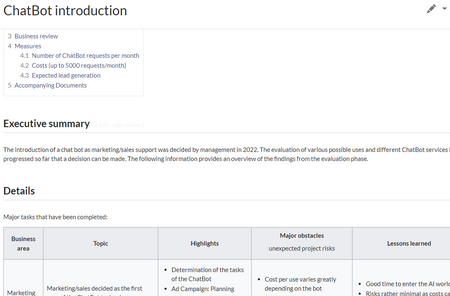
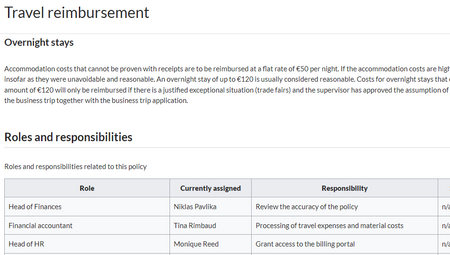
|content=<div class="screenshot">[[Screenshot customer documentation.png{{!}}600x600px{{!}}link=Customers]]</div> | |content=<div class="screenshot">[[File:Screenshot customer documentation.png{{!}}600x600px{{!}}link=Customers{{!}}alt=Screenshot of the customer list]]</div> | ||
|hdstatus=Nein | |hdstatus=Nein | ||
}} | }} | ||
Revision as of 14:25, 17 April 2025
A knowledge base is a place where the knowledge of an organisation, department, or team can be centralised. Employees collect their team and department knowledge and companies use it to provide an online helpdesk to answer frequently asked questions (FAQs) and share best practices.
Finally, you can find information about products, services, events, organisations, locations and partnerships.
Wikis as a knowledge base
Wikipedia and its sister projects are undoubtedly the most popular knowledge bases. Wikis are created to easily and collaboratively add or update knowledge dynamically.
Different contributions are quickly linked together. Over time, wikis become more valuable as the links become richer and more complex.
Wikis, and in particular the Wikipedia software MediaWiki, are designed to allow knowledge to be aggregated and individual wikis to be combined.
Example pages